

 Apple Podcasts
 Spotify
 Overcast
 PocketCasts
 Castbox
 Castro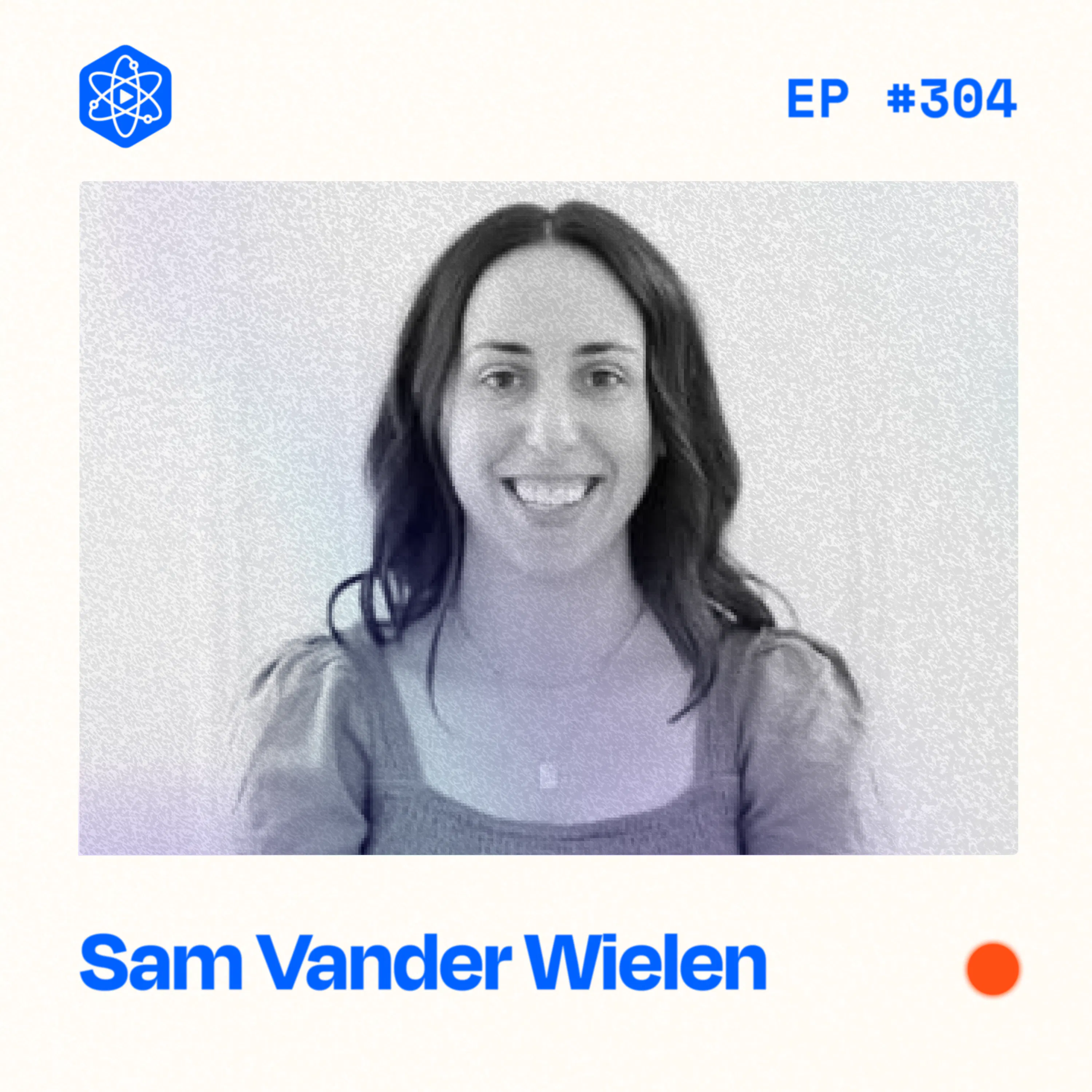
Sam Vander Wielen is an attorney-turned-entrepeneur and creator of The Ultimate Bundle.
Sam Vander Wielen is an attorney turned entrepreneur who built the go-to legal template shop for online businesses. Her flagship product, the Ultimate Bundle, a package of fill-in-the-blank contracts and video trainings, has generated over $8 million in lifetime revenue and now earns close to $2 million per year with essentially one full-time employee. She published her first book with Hachette in April 2025, and she runs everything through a single evergreen webinar funnel that quietly generates six figures a month between launches.
I met Sam at Craft and Commerce last year, and when I saw her post about 10,000+ webinar registrants and a $500,000 launch, I knew I had to talk to her. What blew me away wasn't the numbers; it was the simplicity. One product. One funnel. Two launches a year. Relentless customer research. She's the clearest example I've seen of someone who found the main thing and refused to let anything pull her off it.
- Sam Vander Wielen
- Sam's Sidebar Newsletter
- The Ultimate Bundle
- Book: When I Start My Business, I'll Be Happy (Hachette, 2025)
- On Your Terms Podcast
- Sam on Barrett Brooks' podcast (referenced in intro)
- VideoAsk
- Growth in Reverse (Chenell Basilio) — referenced interview
Full transcript and show notes
***
TIMESTAMPS
(00:00) Jay introduces Sam and her $8M+ legal template business
(02:27) What the Ultimate Bundle actually is — and why it hasn't changed much since 2017
(03:47) The Olive Garden effect: how Sam thinks about community and lifetime customer support
(10:00) The $500K launch breakdown — what went right and why it wasn't an accident
(13:28) Sam's full launch strategy: the teaser period, invite period, and treating registration like concert tickets
(18:03) The on-webinar bonus that drove 128 purchases live — and why a book beat a $100 discount
(22:56) How Sam uses VideoAsk to boost show-up rates and make 11,000 registrants feel personally seen
(28:39) Voice of customer research: quarterly customer calls, AI transcript synthesis, and why Sam still reads the raw transcripts herself
(33:14) Why working less keeps making the business better — and what the 'entrepreneurial gap year' actually means
(36:04) What motivates Sam (honest answer: fear) — and what Jay relates to in that
(42:00) Why AI isn't a threat to Sam's business — and how she reframed the 'doubt language' from Google to Claude
***
RECOMMENDED NEXT EPISODE
***
ASK CREATOR SCIENCE
***
WHEN YOU'RE READY
***
CONNECT
***
SPONSORS
Learn more about your ad choices. Visit megaphone.fm/adchoices
Sam Vander Wielen [00:00:00]:
I was like, you know what? I want a year off mentally. And it's really funny because I've had more opportunities come my way than ever before. I think every year is going to be a gap year from now on. Like, this is it. This is the new normal.
Jay Clouse [00:00:27]:
Hello my friend. Welcome back to another episode of Creator Science. This week I'm speaking with Sam Vanderwelen. Sam is an attorney turned entrepreneur who built the Go to Contract template shop for online businesses. It's generated over $8 million in lifetime revenue and earns nearly $2 million per year right now, with essentially just one full time employee. Sam's business is built almost entirely on one product called the Ultimate Bundle, One funnel, including an evergreen webinar and her weekly newsletter. Sam published her first book in April 2025 titled When I Start My Business, I'll be Happy with Hachette. And along the way, Sam has navigated serious personal hardship and grief, undergoing brain surgery and losing both of her parents, all while keeping the business running.
Jay Clouse [00:01:11]:
I met Sam for the first time at Craft and Commerce last year at an event organized by Barrett Brooks and Shawn Blanc. Shout out to you too. She's done a great interview on Barrett's podcast as well, which I'll link in the show notes. As you'll hear in this conversation, I I am blown away by the elegance and simplicity of her business. She's one of those rare people who has kept the main thing, the main thing for years, talking to her customers, relentlessly iterating launch after launch. And now she routinely achieves launches in the hundreds of thousands of dollars. And listening to her story. She makes me believe I can do it too.
Jay Clouse [00:01:44]:
If you're enjoying this episode, tag me a Klaus and Sam Amander Wielen on Instagram and let us know. We'll get to that conversation right after this. Sam, we're doing it. We're recording a thing. We're finally getting some time to sit and chat with one another. I saw a message from you that you had over 10,000 registrants on a webinar and I went, what? And it triggered me to schedule this. So I want to talk about the launch and I want to talk about a few things, but I think to set the table and give some context, your major product is called the Ultimate Bundle. And for folks who aren't familiar, can you describe what that product is?
Sam Vander Wielen [00:02:27]:
Yeah. So the Ultimate Bundle is a package of legal templates, downloadable, fill in the blank, kind of like more boring Mad Lib style contracts, and a package of online trainings or video trainings where I'm walking them through soup to nuts. How to start an online business legally. That's really it.
Jay Clouse [00:02:43]:
How has that changed over time?
Sam Vander Wielen [00:02:45]:
You know, it hasn't actually changed that much over time, which is I think part of what has made it really good and successful. I started it in 2017, early 2018 and obviously I keep the legal templates updated and trainings updated and I've added things, you know, as, as I start to see trends either in the industry myself or as I start to see trends amongst my customers asking me the same questions over and over. Like recently it's mostly been around AI and asking if you know, there's something that they can put in their contracts regarding AI and like they're using their customers info on their GPT or in the reverse of saying like, I want to make sure that GPT can't crawl my site and use it for AI. And so people are asking me for all sorts of disclosures and language. I'll go in and add it. But outside of that, it's essentially been the same.
Jay Clouse [00:03:34]:
There's an aspect of it that's like community support. How big of an aspect do you believe that is to the selling of the thing or the overall and, or the overall like experience of the thing?
Sam Vander Wielen [00:03:47]:
It's everything. When I think of community, I think of it both in the pre customer experience of the picture. Essentially I paint for people upfront about what it's going to be like if they actually end up being my customer. And so I take customer service really seriously. I did that from day one when I had three customers. I was offering Ritz Carlton level customer service to people. And I maintained doing that myself for a really, really long time. And, and now it's very, very clear with my one person on the team, Leanne, who handles incoming customer stuff, that that is the expectation level of service for them.
Sam Vander Wielen [00:04:20]:
And then once people are in my community, it's the same thing. I have, I wrote about this in my book, but I have this whole like what I call the Olive Garden effect thing. Cause my, my late father was obsessed with the Olive Garden. And so I.
Jay Clouse [00:04:32]:
When you're here, you're family.
Sam Vander Wielen [00:04:34]:
Yeah, exactly. And so I'm like, once you're in, you're in. It's like the Mafia, right? And so I really pride myself on taking care of people once they're here. And I think what's really interesting is that as your business grows and you get a lot of volume, like how do you maintain that but also how do you maintain your boundaries that that actually doesn't start to dip into like always trying to make people happy, which can be really easy for me too. So it's been a really interesting balance, but by far our customers always say like the community support in our actual community, plus like the community of, I don't know, just feeling really supported by me and the team is invaluable.
Jay Clouse [00:05:09]:
Tell me more about that. How did you solve that problem? Because when you sell a one time purchase product, but you're promising essentially ongoing support to some degree, that is like a growing support need over time. So how did you guys solve that? Do you find that the scale of support needed has been linear with the amount of sales or has it kind of plateaued at some level?
Sam Vander Wielen [00:05:32]:
It plateaus in a way because what I thought of was like, look, people aren't going to have the same level of questions forever. So what I tend to have is like these people come in, they're just starting a business and for a couple of months they have a lot of questions. Years down the line, they don't have the same level of questions. But think about how much of a value it is that four years later they can go in and post in my community and ask me a question. If they have one question four years later, I am happy to do that. If that also means that that keeps them happy, they're continuing to use my product, it's continuing to be valuable to them. Do you know how many other people they tell about this thing? Do you know how much I'd have to pay in ad dollars or whatever else in order to go out and acquire that customer? It is so worth it if it means answering some questions. Happy to do it.
Sam Vander Wielen [00:06:17]:
I also though think that like, as I got more mature in it and started to find my confidence in that my product itself is very valuable and that I worked very, very hard to make the product itself so good. I stopped reinventing the wheel and I asked the team to do the same. That when someone asks a question that I have answered within the training videos, your job is to point them to the training video, not to reinvent the wheel. And that started saving us a lot of time as we grew.
Jay Clouse [00:06:41]:
Yeah, this is the big downside of a membership model. I think I heard Ewan Barret talking about this on his podcast where like the grass is always greener no matter what your model is. So I'll talk to you today. I'll be like, damn, I should really have a one time purchase thing. That's a high Touch thing that has a forever community. And then maybe there's some aspect of you or someone else I talked to who's like, damn, I really should have a membership. That's recurring revenue. But the downside of a membership model is the people who buy into your membership are your biggest supporters, your biggest fans.
Jay Clouse [00:07:11]:
And no membership is forever. So you set up this situation where your biggest fans will eventually decide it is no longer worth it for me to pay for this thing. And it leaves on kind of a weird note. Whereas in your situation where you have this ongoing relationship where it's like, I realize the value of what I purchased immediately, and I'm still reaping the rewards of it for years down the line without additional purchases. That's a pretty nice system. But part of the reason it works is because there is some margin built into the price of your product. But maybe I'm overthinking that.
Sam Vander Wielen [00:07:45]:
No, I think you're right, because it's a big part of why I've been so resistant to the affiliate model that was so much more popular when I started in 2016. And everybody was just doing these. You know, you find a handful of people and do these gigantic affiliate launches with them. And I would think, like, if it meant I had to give up 50% commission on my product, I don't want to do that because it's a simple email for them, and then I'm taking care of these people for life. So I just didn't invest in that way of growing the business early on. I'm kind of glad I didn't for this very reason. But I also just think it's paid itself over many times in terms of referrals and customer happiness. Completion rate of that.
Jay Clouse [00:08:20]:
So for the final kind of context question, how would you describe the stage of business that customers of the ultimate Bundle are typically in? I'm sure it's a spectrum, but how would you kind of proportion that out?
Sam Vander Wielen [00:08:33]:
Yeah, I would say at least 60% of our customers are the. I have this idea I'm starting the business. I'm getting all of my ducks in a row, except I have no idea what those ducks are, and I don't know which row to put them in. And so that's what they're coming to us for, to just save them a lot of time and, like, get them off and running really quickly. I think, like, the second largest chunk of our people is really, like, people who almost, like, accidentally started a business. Maybe they had a 9 to 5. They started posting content online, and then they were like, wait, I think I have something. Or, you know, my friend Jay at work is texting me saying he's ready to work with me, but I don't have anything in place yet.
Sam Vander Wielen [00:09:07]:
And they're the, like, I need to get this in place fast people. And so they're really ready to go. I would say the last 10%. I attract a lot of professionals, maybe because I'm a lawyer, but, like, I attract a lot of professionals, like doctors, lawyers, accountants, nurses, therapists, lots and lots of therapists who want to start some sort of online business beyond their job. And so that's really. That's been really, really interesting to navigate. And they're really cool group of people.
Jay Clouse [00:09:34]:
So you just had this launch, and it was over $500,000, your biggest launch ever. On one hand, it's kind of like, well, of course, shouldn't, like, every successive launch be the biggest launch ever if, like, you're getting better and better? But that's not the way most people experience their launches. A lot of times it's like, I've exhausted my list. This launch isn't as big. So tell me what you think went right with this launch that we can learn from and we can start to disentangle other ways that people can emulate this.
Sam Vander Wielen [00:10:00]:
Yeah. I'm so excited to share this with people because I think so much went right and it was really, really intentional. None of it was an accident. So I'm always happy to tell people. I just think, for context, it's important for people to know that I had just had a $400,000 launch, like, not even two and a half months earlier. And I. My rule, my internal rule is that the day after a launch is done, I immediately go back to email, is building, like, literally, I'm on Instagram, my podcast, everything flips. Like, it's like a wedding, you know? And I'm right back to getting the list built up.
Sam Vander Wielen [00:10:31]:
I was nervous, though, that I hadn't built it up enough. So I was like, how are we going to pull this off? I'm not really sure. So I wasn't expecting it. I think some of the things that I did really right this time around were, for example, starting to treat my meta ads as a social media channel of their own. And I think this is something that not enough people are doing. So I give my ads the love and care and attention that they deserve. Like, the same way that we would create a podcast episode or that we would create a piece of organic content on Instagram or TikTok or wherever else. So I do this in two ways.
Sam Vander Wielen [00:11:02]:
One, I create content for that ad channel, essentially like organic content for ads. But I also test a lot of things through my organic channel and whatever does well, I turn it into an ad. And I think that people don't understand. Like they think, oh, that means you boost the ad. No, you actually pull the video and you use it and create an ad because you really want all the audience control that you can get through meta. And through doing that, that was like the. Just the best way that I think things took off. I also decided this launch that I would give myself a little bit more room and flexibility during the launch itself, that if something popped up that was timely, I would hop on it and capitalize to get people to my webinar and really have to be creative to figure out, like, how am I going to get people for whatever topic to my webinar.
Sam Vander Wielen [00:11:48]:
So for example, when I was in the pre launch period, this thing popped up with TikTok, I guess changed its terms and also ChatGPT changed its terms. And so I literally sat on the floor of my office that I'm in right now and I recorded a video that I was like, I'm a lawyer and I'm really worried about some of the things that are going on in the online space. I named a couple of them and I was like, that's why I'm going to talk about them at my free live webinar. And we got thousands of signups from that one video. And so that was literally something we just chopped up like very quickly and ran with. So those are just a couple of things that I think really, really helped move the ball this time.
Jay Clouse [00:12:25]:
Wow. So you mentioned that you had this big launch two and a half months earlier than this launch is a two to three month time period. Kind of the rolling period between launches. Or did you decide to have two successive launches earlier than typical?
Sam Vander Wielen [00:12:40]:
It had gotten a little crunch. I messed up last year. Just the timing. Because as you know, my book came out last year on April 15th and then. Happy Anniversary. Yeah, thank you. Yeah, exactly. And it just messed all the launch timing up.
Sam Vander Wielen [00:12:54]:
And I was doing a lot of speaking gigs and I kind of crammed everything in at the end of the year. So my launch last year was a little later. I like to have it in September, whereas this one was in very late October into November. And so it was just a little too close for my liking. Turned out it was okay. So that was interesting, like even for me to mentally play with of like Oh, I thought I had a whole story about. This is too quick. The list is exhausted.
Sam Vander Wielen [00:13:17]:
I haven't built it up again enough and it was fine.
Jay Clouse [00:13:21]:
So we have the social strategy, we have the webinar strategy. Maybe we should talk about just the overall launch strategy you use when you do these launches.
Sam Vander Wielen [00:13:28]:
I like to reverse engineer. So the very first thing I do is pick a live date for the webinar. It's kind of like my bookmark. And so when I pick that date, then I reverse engineer for two weeks before that live webinar. That's my invite period. So that's like going hard in the paint, just literally inviting. Every single thing is talking about this webinar, getting people to it for two weeks before that. I call it my teaser period.
Sam Vander Wielen [00:13:51]:
And so that's when I say, I'm announcing something, something's coming, something I've actually started doing more of that I think is working really well is that I will say the thing that is coming as a live webinar, like I'm much more upfront about it. And I'll say like, I'm opening the doors. I almost treat it like, I don't know, a concert ticket. And so I'll say like, I'm opening the doors to be able to register for my free training on Monday, January 19th. These fill up really fast. So like, get the seat. And I'm talking about it for so long. I'm also starting to lay the groundwork during that time period of this is all what's going on in the industry.
Sam Vander Wielen [00:14:22]:
These are the things that are shifting. This is what people are worried about. And I've really started to tailor my webinar itself to more timely what's going on in the industry. Whereas I used to always just keep it to like these five steps that you have to take to legally start a business. But now I've added in a section that's essentially like a state of the online business union and I'll tell you what's going on. And like these ADA lawsuits, for example, they were very popular when I had the webinar. I mean, they still are, but they were really popular when I was advertising the webinar. And so I leaned into it heavily.
Sam Vander Wielen [00:14:53]:
That's not something I used to do.
Jay Clouse [00:14:57]:
So you have this two week lead up when the doors are open to register, you have the two week teaser beforehand. This is a four week period of talking about this launch. A lot of people listening to this may be feeling the concern of like, will that just annoy people who are already like close to me and paying close attention. Do you think that's true? And if yes, does it even matter?
Sam Vander Wielen [00:15:18]:
Yeah, I mean I haven't seen evidence of that. I mean we watch the unsubscribes closely and it hasn't, it doesn't change. It's not any normal than like my typical unsubscribe rate which with having 66,000 people is always going to be a few people, you know, unsubscribing. Which is fine and I'm fine with that. But no, I mean I. This is where I think it really. And I don't say this is someone that this comes like naturally to me, but this is really where you have to work on the mindset shift of like if they want to leave, they can leave. Also, don't mistake people for leaving, for meaning that they never will buy or that they don't need what you have or whatever.
Sam Vander Wielen [00:15:49]:
Sometimes people just don't want your emails. I've had people email me and be like, I'm going to buy your thing, lady, I just don't want to hear from you anymore. Which is fine for me. Right. It's like I don't, I don't care. And I understand. I get inundated with emails too. I also would tell everyone that there is a way to make these emails really valuable so that they are not just announcements.
Sam Vander Wielen [00:16:07]:
They are not just, hey, I have this thing coming. So I my emails, if anyone gets my weekly newsletter, Sam sidebar. You know, my emails are very story driven. They are full of value every single week. I am still doing that. While weaving this in to those emails,
Jay Clouse [00:16:21]:
would you say that every piece of content you're publishing or what proportion of pieces of content that you're publishing during this four week period have a direct call to action that hey, this webinar's
Sam Vander Wielen [00:16:31]:
coming 100%, 100%, 100%. And also something very tangible that people can do is that I started playing with add to calendar stuff in my email. So first of all, we only last year started doing add to calendar for the webinar itself which like I don't know what took me so long and that really helped. And I have some like helpful tricks we can talk about later with some of the things I did around that. But even in the invite period and the teaser period, I started treating it like a Taylor Swift countdown of like an album coming. So we actually added an add to cal button to let you know what day registration started and we really started pushing people to click that too. So, yeah, 100% of them were either reminding people, I have this thing coming or the call to action really was like, add this opening thing to your calendar.
Jay Clouse [00:17:17]:
I have some of the numbers that you shared in a recent podcast episode, which I'll put in the show notes where you talk about this too. I saw you had about 11,000 people register. 25% of these people showed up live. And then 5% of those people converted to purchases on the webinar on the webinar.
Sam Vander Wielen [00:17:33]:
So it was higher overall. But on the webinar we had a 5% conversion.
Jay Clouse [00:17:37]:
What do you think is the proportion of purchased on the webinar versus purchased after it was done?
Sam Vander Wielen [00:17:42]:
It was huge. We had 128 people buy on the webinar sitting there. So it was huge because I think we had 268 total.
Jay Clouse [00:17:50]:
Okay, so.
Sam Vander Wielen [00:17:51]:
Yeah, right, exactly. So I think it was huge for me, given like my past experience with webinars. And I did some very specific things on the webinar to make that happen this time.
Jay Clouse [00:18:01]:
What are those things?
Sam Vander Wielen [00:18:03]:
So one was that I have started to play with this idea of giving an on webinar for financial bonus, which I had never done before. But I also noticed that even with the financial bonus, sometimes people, there's just something like, okay, for $100, I'll take some time to think about it because it's a large purchase and I understand. And I'm actually not a very salesy or pushy person. And so there's that. But I this time offered everyone who bought on the webinar a copy of my book and a seat at book club. So I'm running my live book club. I did. When my book came out last year, I ran a live book club call and thousands of people came to it.
Sam Vander Wielen [00:18:38]:
But people who've bought the book in the last year have been like, oh, I wish you did book club again. So this was my way to really put like some emphasis on if you want some time with me. I don't do any coaching, I don't offer any services. And it works really well because my book is all about how to market an online business. It has nothing to do with legal. And so I was like, look, this is perfect. You get the bundle, get all your legal stuff, then you get my book and you get to come to a call with me, like buying out. And it was just, I couldn't believe how many people were so interesting.
Jay Clouse [00:19:06]:
Cause a copy of a book is like $30.
Sam Vander Wielen [00:19:08]:
Maybe it doesn't cost us that.
Jay Clouse [00:19:10]:
And so like, and that was probably a more effective incentive, as you're saying, than like a hundred dollars off.
Sam Vander Wielen [00:19:15]:
Yes, exactly. And also there's. I mean, if anybody has a book or wants to write a book, then you know, too, that there's. You have to be really creative with some of the things. A lot of this falls on authors to sell their book. So it also gave my book a huge boost, and it gave us, you know, the ability to buy tons of copies of my book and then send them out. We also send handwritten notes with every single one, which then we ask them a question to post the answer to on social media, which then gets them to follow me on social media, which then gets us engaging. I have a whole loop built in.
Jay Clouse [00:19:45]:
Yeah. So interesting.
Sam Vander Wielen [00:19:46]:
Yeah.
Jay Clouse [00:19:47]:
Okay. So some of these numbers that I shared, 25% show up rate, 5% webinar purchase rate. When you look at the results of this launch and I have a sense from your brain, you're already thinking about the next launch. Which levers are you most interested in pulling to try to make the next launch even better?
Sam Vander Wielen [00:20:07]:
Yeah, I will definitely do the timely content again. I see how much that really helps. And I've already talked to my social team about when we plan out. We usually plan months and months in advance to create all the content. I batch, film it usually, and then they have everything ready to go. We're leaving, like, little placeholders throughout the calendar of, like, this will be something Sam will send us. This will be something that's viral. This will be something that's timely or trending, a hot take of some sort on something that's going on.
Sam Vander Wielen [00:20:33]:
So that has been really helpful because it's allowing us to not create so much upfront work for ourselves and then give ourselves wiggle room in the schedule. So I'll definitely be doing that again. I will definitely be playing with my ads and seeing even which ads work, you know, really well. Another really good tip that I wish somebody would have told me earlier is that when I do my batch days of content now, anything that I do that's evergreen, where the call to action is my webinar, because I run this webinar 24. 7 as an evergreen funnel, and it works beautifully. We make six figures a month on than just the evergreen webinar. So every single time I shoot a piece of content for it, I do my call to action and then I pause and then I do my call to action. I say it again with an ad call to action in mind because you can't use manychat with ads, or at least you shouldn't all the time because it can trip off some bot things and get your ads banned.
Sam Vander Wielen [00:21:19]:
So sometimes we have to say like click to purchase or click to sign up instead of comment class to sign up.
Jay Clouse [00:21:25]:
I see. Interesting.
Sam Vander Wielen [00:21:27]:
So I'll record those ahead of time so that if when, for example, the organic version of that piece of content goes up and it starts to do well, we already have it in the bank to be like, run it as an ad. You already have it. I don't have to reshoot anything, I don't have to do anything. Takes me two seconds. But it's a huge value add to the team.
Jay Clouse [00:21:43]:
That's so interesting. What I thought you would say when I asked that question was like, oh, we're gonna try to increase the show up rate in this way or we're gonna try to increase the conversion rate in this way. But you went to signups, it seems like. Do you feel like that's the biggest lever for your launches?
Sam Vander Wielen [00:22:00]:
I think so, because I'm getting more confident on the things I'm doing that are helping. I've improved my show up rate significantly. This was something I struggled with before. I could get people to sign up, but I couldn't get them to show up. So I've worked really, really hard to get that show up rate. The add to calendar button was one of the things that really helped. Video Ask is another thing that's been significantly improving my show up rate and my sales for frankly. And so I feel better with that.
Sam Vander Wielen [00:22:24]:
I feel often like if I can get people in the door, then I, I know what to do from there. I also know that I take such a long term business approach that I don't mind if people don't buy from me right now. I know that that's very controversial thing to say in our industry, but I'm okay if people are like, ah, it's a little too soon. I'm gonna hang out, I'm gonna get her email every week, maybe I'll read her book, maybe I'll listen to her podcast and then they buy in the next one. So it helps me to grow my list. I can get in front of them, continue to nurture them. It's all fine with me.
Jay Clouse [00:22:54]:
How are you using Video Ask?
Sam Vander Wielen [00:22:56]:
Oh, I love videoask. So okay, I'm using videoask primarily on the front end. When people sign up for the webinar, they get a confirmation email through kit so you know they'll get tagged, get the confirmation email through kit and then the email itself is super short, and it will just say something like, hey, Jay, thanks so much for signing up for my free legal workshop on whatever date. And I just have a really quick question for you. What's one thing you want me to answer in my live workshop when they click on it, as you know, but in case everybody else doesn't know, it will then bring them to Video Ask. There's a short video from me that it kind of looks like a FaceTime video. I very purposefully went to the mall. I'm not kidding.
Sam Vander Wielen [00:23:33]:
To walk around and just film it. Like, it looks like it's somebody sending you a video. As a friend, I'm not at, like, a polished desk, no polished setup. That's my style. And it works really well. It also gets people to watch the video. And I'm just saying, like, hey, I'm so glad you're coming. I just want to know.
Sam Vander Wielen [00:23:48]:
I want to make sure that this is as valuable to you as possible. What's one thing I can answer? And then they can send me a video back. They can send me a voice note or they can text me. And so every single person who sent me one of those, I sent them a video back, a custom video for them, until the last day when I had, like, 83 pending and I sent a mass. You know, thank you, and I can't wait to see you there, because I couldn't do it anymore.
Jay Clouse [00:24:12]:
Yeah, I know that a big part of your story is you've created a lot of space for yourself because this business is working so well. It strikes me that, like, anytime something's working, you guys systematize it, operationalize it, iterate on it. How would you describe your use of your time? How is your time deployed in the business week to week right now?
Sam Vander Wielen [00:24:36]:
Yeah, I think I'm the chief marketer. I mean, that's how it feels, right? It's like most of my time is spent creating. I try to create as much evergreen content as possible. So content that can continue to pull in leads for me, regardless of whether somebody finds it today, six months from now, a year from now, you know, really taking care of my customers. That's probably the second biggest use of my time. And third is really kind of just dreaming up and thinking what's possible and being creative. Honestly, I think the more I do that's not related to my business, the better my business gets. So I spend a lot of time not working.
Sam Vander Wielen [00:25:09]:
I take a pottery class. I love working out. Like, I spend time with my husband and my dog. I do a lot. I travel a ton. And so I do a lot that. The whole time I'm doing that, frankly, I come up with ideas that's usually. And it's usually the fodder for all my stories that I write in my email that then convert to some business lesson.
Jay Clouse [00:25:27]:
Yeah, I want to put a pin in that, because that's something I want to talk about here in a second. But I hear a voice of the listener in the back of my mind that wants to know, on these webinars themselves, what does the mechanism of the pitch look like? Is it like 45 minutes of value and then 15 minutes of pitching? Is it interwoven in? How would you describe where you've landed in terms of. This is what works the best for me.
Sam Vander Wielen [00:25:47]:
Yeah, we could do, like, a whole podcast episode about my webinar. Cause I think this is really where I have honed in, and I have a lot of people who come just to observe me, and they will tell me afterwards of, like, whoa, there was a lot there. So, first of all, I want to give everybody some very specific webinar tips here. I obviously, it starts with just, like, an intro, welcoming them, telling them who this is for and who it's not for. But I want to mention that the language that I'm using and this is something I do across my business is straight out of the mouth of my customer. I spend a lot of time doing voice of customer research. We have quarterly customer calls that are recorded. We use the transcripts of those.
Sam Vander Wielen [00:26:22]:
We pull out commonly used phrases. I am literally plopping those phrases. Boom, right into the webinar. And. And the people in the chat are lighting it up, being like, yeah, that's me, that's me, that's me. So that's something that I'm doing off the bat just to make people feel, I think, really seen and, like, they're in the right place. And then I also, really quickly, off the bat, say, you're not in the right place. If you're going to get mad when I talk about my product.
Sam Vander Wielen [00:26:45]:
At the end of this free training, I'm about to give you about an hour's worth of free legal tips and structure about how to start your business. But is it cool with you if, at the end, I share with you about my product? I need you to put yes in the comments, and. And then the comments just, like, light up like crazy.
Jay Clouse [00:27:00]:
You do that in the beginning, right
Sam Vander Wielen [00:27:02]:
at the start, yes. I'm very upfront about it. Even in the emails, I tell Them in the, in the invite emails, in the show up emails that I will be talking about my product. I intro the product, I start laying the groundwork for what the product is, who it's for, what it includes all that stuff up front so that they're coming to this webinar and they're like, wait, she just gave me all that training and now I just realized, like, the bundle is exactly what I need. But asking them for their consent completely flips it around, I think. I think people relax in the salesy thing. And I also noticed that I immediately start seeing comments in the chat of like, wow, you're so not like, like all the other people that I've gone to webinars for. Right.
Sam Vander Wielen [00:27:37]:
And that's very different. The second very specific, like, sales thing I do right off the top is I say I'm going to talk about the ultimate bundle at the end, and if it's right for you and if it's right for me, then I would love for you to join. And I make it so that it's a mutual thing that, like, I'm not just somebody who's here to extract money from people who don't need my product. Right. And so I'm very upfront about, like, who it's for. This is what I help with. I don't give you legal advice, you know, all of this stuff. And so I want to make sure this is right for the both of us.
Sam Vander Wielen [00:28:04]:
I think since I started doing that, it really disarms people from feeling like I'm trying to sell them and like I want to sell them something no matter what.
Jay Clouse [00:28:12]:
After a quick break, Sam shares how she pulls together the in depth customer research that feeds the flywheel of her business. It's so, so good. So don't go anywhere. We'll be right back. And now back to my conversation with Sam Vanderwelen. You mentioned a second ago that we do a lot of voice of customer research. I've heard you talk about this before. You talked about it on Chanel's podcast, Growth in Reverse.
Jay Clouse [00:28:39]:
But I would love for you to take a second to describe what that means so that people get a sense for what the scope of that actually is.
Sam Vander Wielen [00:28:45]:
Yeah, so we essentially do. My copywriter, Caitlin and I, she's a contractor for me. She doesn't work for us full time or anything. And the only thing I have her write are the sales emails that go out for the two weeks before the launch. So I write everything else myself. But when it comes to, like, sales psychology or Any of this kind of stuff. It's really important to have a pro doing this. And so Caitlin will meet with our customers regularly.
Sam Vander Wielen [00:29:07]:
So she'll ask for a list of people who've bought the bundle in the last month or whatever. She reaches out by email, ask them to book a call with her on Zoom. We asked for their consent to record it, of course, and create a transcript out of it. And then she's popping that into AI and putting all those transcripts together to see, really to pull out the trends. Back in the day we literally used to put this into like an Excel file and I was scrolling through and looking and being like, oh, I see people keep saying the same stuff over. So there's a lot of that going on. And we're getting reports from her back regularly being like, I'm starting to see this change in customers language. I'm starting to see people talk about it like this or this is where they are in their business journey.
Sam Vander Wielen [00:29:47]:
This is the language they're using. But I'm also regularly in there in the DMs, for example, customers write to me all the time about the bundle or they share about it. I will start voice noting them back and forth. I will ask them, I will email with people. When we went to Craft and Commerce last year, so many people came up to me and were like, I'm a customer. I have no idea who they are. I've never met them or heard of them. And I asked them a million questions.
Sam Vander Wielen [00:30:11]:
Actually, this is something I was thinking about yesterday. Nathan Barry emailed me because he was like, I mentioned something to him last week when I saw him in person about something on Kit. And then he wrote me yesterday and he was like, I want you to tell me more about what would it take to get you to come over to use this part of our product instead of this other software you're using? Like, what are we not doing that you want? And I was like, that's exactly what he should be doing.
Jay Clouse [00:30:34]:
Yeah, I have two follow up questions. So answer them in the way that you want. So you mentioned this contractor who's sales voice of customer specialist. Is that a annual contract? Is it monthly, is it seasonal? I'm curious about the mechanics of that and I'm curious how you guys collaborate and actually track these insights.
Sam Vander Wielen [00:30:52]:
Yeah, so she's on a project basis. So it's just like I have two launches a year. I say, hey, we need the sales emails most of the time. I mean like after the sale we just had, it's going to be a refinement package versus, like, writing copy from scratch. So she's essentially going in and updating those emails for any of the new customer interviews that she's had. Otherwise, it's essentially her holding those voice of customer research calls. We get notified because we send whatever customer did it, we send them a gift to thank them for having done it, which we don't tell them ahead of time that we're doing that. And then Caitlin's putting together a report and sending it to us to review.
Sam Vander Wielen [00:31:27]:
And so essentially I'm spending a lot of time digging into that. She also gives me access to all the original transcripts myself, which, I'll admit, I go in and look like I don't want a summary. I want to go in and I want to read it myself. So. So I do take a lot of time to look at that.
Jay Clouse [00:31:39]:
So. Good. When I listen to you talk about this, and when I've listened to other interviews with you, it feels like the Sam empire has been just up and to the right forever. Obviously, I know you've had some personal grief stories that we don't need to get into unless you want to, but from a business perspective, have you had down years, bad years, difficult seasons?
Sam Vander Wielen [00:32:01]:
Not yet. I've not had it. It's been pretty straight up since I started, to be honest. I mean, I would say, like, what Jay was referring to is that both my parents died in the same year recently. And when my parents died, I kind of kept everything like the same. But it was really interesting because last year was the first year I had where neither parent died. And. And my book was coming out, and I was like, I guess, surely, like, the business is going to take a hit because I'm focused.
Sam Vander Wielen [00:32:27]:
I was focused so much of my attention on the book. My book came out April 15th. We flipped everything to be book only on, like, January 1st. And so it was such a hard push, and it was exhausting. And I did it all myself. I didn't hire anybody from the outside, so I thought for sure it would take a hit. We did better last year than we did the year before. I'm obviously already on track this year to do better than last year.
Sam Vander Wielen [00:32:48]:
So part of me doesn't really understand it, to be honest with you, because I know I told you, like, privately, I'm like, I feel like I keep working less, but yet somehow this is what's happened. But I. I think what sticks out to me when I talk to other people and, like, why they're so mystified about this is that I just keep things really simple. And I think a lot of times people just harm themselves by going out and starting all these different things and not just charging forward with what's already working.
Jay Clouse [00:33:14]:
Yeah, that's. That's one lesson I've had. And even just researching this interview is like, yeah, you found a product. You've continued to make the product better and exactly what it needs to be because you talk to your customers. It also seems like that product has a very clear utility to the person purchasing it. So, you know, it's always better when you don't need to create demand for your product.
Sam Vander Wielen [00:33:34]:
Yeah.
Jay Clouse [00:33:35]:
You know what I mean? And there are a lot of creators who, like, they spend a lot of time basically generating demand for their thing that's not so much of a painkiller as it is a vitamin. But I do think it's also interesting that there is this correlation between as you create more space and quote, unquote, work, less things improve. Like that could be, and probably is to at least some degree, all the legwork you've done to this point. But I do think there's something about not white knuckling the business. And you've been calling this year, like, your entrepreneurial gap year, which I think is super, super interesting as a concept. It's intuitive because people hear, like, gap year, they kind of know what you mean, but it doesn't mean you're not working. So can you share what you mean when you say a gap year?
Sam Vander Wielen [00:34:22]:
Yeah. So when I think gap year, like, this idea came because I was somewhere years ago, like, I was in Jordan, I think, and I met a group of, wow, call them kids, because I'm an old lady at heart. And they were probably like four years younger than me. They were on a gap year from Australia, and we were talking about how in Australia, this is something everybody does, right? And their gap year is a year to go out and explore, find themselves, experiment, try things that are new to them, have new experiences. Right. And so coming off a year where I was pushing so hard for this book, still running this business full time, you know, still navigating grief, like, pretty fresh grief. I was just like, you know what? I want a year where I don't try to figure everything out, like, what's next for me, I'm really, really hard on myself. I am harsh, harsh critic of myself.
Sam Vander Wielen [00:35:11]:
And I don't think anything I do is that special or unique or good enough or anything else. And so, yeah, it's just like, I was like, you know what? I Want a year off mentally, I don't need a year off of not working. I don't work that crazy. What I need is to stop berating myself to figure out what's the next step, what do I need to be doing? Everybody's on this app. I should be on that app. I'm not doing good enough at this. I didn't sell enough of my book. I didn't do this thing.
Sam Vander Wielen [00:35:34]:
How about I just like chill and let myself be? And it's really funny because I've had more opportunities come my way than ever before. I've had obviously a lot of business growth. And yeah, I just, I'm feeling better. I just joked with my only full time employee, Lindsay, who I love. I was just joking with her the other day. I was like, I think every year is going to be a gap year now. Like, this is it. This is the new normal.
Sam Vander Wielen [00:35:58]:
Yeah.
Jay Clouse [00:35:59]:
What do you think has motivated you historically and is that still true now?
Sam Vander Wielen [00:36:04]:
Fear.
Jay Clouse [00:36:05]:
Okay, interesting. So I'm asking because I'm relating to you in a lot of ways. But also I've always had a hard time of once I cover my needs financially, that just seems to be where I plateau in the business is like, once I've kind of covered my lifestyle, I kind of just like sit there and maybe that's a sign of the products I sell. Maybe it's a sign of the machine of the business that I've built not being as fine tuned. But we talked about enoughness earlier. So I'm curious, when you wake up and you start working in the core business, what is motivating you?
Sam Vander Wielen [00:36:43]:
I mean, there's a part of me that's just like a nerd about this stuff that's kind of excited by the fact that we get to get up every day and do this stuff and it works somehow. I'm like, wait, so I can just record a podcast on my podcast, which is really fun, or I can come here and have this lovely conversation with you and like, this is work. So there's, I think there's a part of me that is, if anybody's ever been in corporate or hated a job before or something like that, there's a part of me that will, I think always and I hope always, feel like I just got out of prison. I feel like I am walking around with a giant smile on my face. Like, I cannot believe that life can be this good because I know how bad it can be. So there's a part of me that just truly, genuinely like, respects and appreciates and is so grateful that we get to do this. And. And then I think, this, this is so fun.
Sam Vander Wielen [00:37:28]:
And I found my creative part. Like I always say to people, I never thought I was creative cause I can't draw or paint. But once we started doing this, I was like, wait, I guess I kind of am creative in this way. Right. This is really fun for me. So there's that. But I am definitely and admittedly terrified of stopping. Like, that's probably just the simplest way to put it.
Sam Vander Wielen [00:37:48]:
Is like, I have to be on a treadmill in life. I had a horribly violent, traumatic childhood. I had a terrible upbringing full of a lot of abuse. And something unfortunately that that brings along with it is never stopping. Right. Because I am terrified. I'm always looking over my shoulder. I assume that sure, things are great now, but like, it could all go away.
Sam Vander Wielen [00:38:10]:
Last week I was at a conference and everybody kept asking me, aren't you afraid the AI is going to wipe out your business? And I'm like, well, I guess I should be. I'm not. But I guess I shouldn't be now. You know, like, that's another thing to add to my fear list. So there's a lot of that of just like, yeah. Having to keep going because I'm so afraid to stop.
Jay Clouse [00:38:27]:
Yeah, I relate to that too. That's part of when you said. When I asked what motivates you and you said fear. I'm like, relate to that. Relate to. Like, my doomsday scenario is like, I have to get a job. That's kind of like my worst case, which isn't even that bad. But like, that is like, the thing that drives me a lot of times is like, man, if I can't keep doing this business, that sucks.
Jay Clouse [00:38:45]:
But then I feel so much pressure around that that I clench really hard. And I don't enjoy the doing of it. So it's something I'm trying to claw my way out of a little bit. I've been doing a lot more reading of books. And what I'm noticing in all of my favorite books that I'm reading right now, especially nonfiction, is so many of the stories are just firsthand stories that are just like amazing lived experiences. And I feel like over the last few years of the business, I have traded in the time for lived experiences, for more time working, which gives me less fodder to like, make interesting content. So I love that you do these things where you go out and you do. You do pottery, you do X, Y and Z.
Jay Clouse [00:39:29]:
I think that's probably Related to the fact that the business continues to grow. Because I think those inputs are just inherently distinct and unique.
Sam Vander Wielen [00:39:39]:
Yeah, a hundred percent. I mean, later this afternoon I'm going to do a beach cleanup and a bird walk. And so like, I mean, I do that stuff all the time. I think that if I could impart like any tip to people, it's that like, if you ever see something being advertised, that there's even just like a little spark of curiosity of like, oh, that kind of looks interesting, just sign up for it. Just sign up for it without thinking about it and start going. It doesn't have to completely make sense, doesn't have to be a 10 week class. It doesn't have to tie back to your business, like just do it. But my mom used to say everybody has to be interesting and interested.
Sam Vander Wielen [00:40:10]:
And I thought that that was like, I wrote about this a lot in my book is that like if you are short on content, if you feel like no one's responding, I'm like, well, how interesting are you? A lot of people aren't very interesting. They're not really doing anything. And just hearing about your business all the time, that's not really what makes to me like you an interesting person. I want to hear about everything pretty much beyond the business.
Jay Clouse [00:40:29]:
Yeah, I agree, I agree. It's interesting that a lot of people are asking you like, are you worried about AI hitting your business? Of course in researching this I'm like, well, it's legal. And that's like one of the narratives of here is something that AI is going to eat. But at the same time, yes, I could have AI generate something, but that hasn't been reviewed. I think a lot of what people want to purchase, especially now with more uncertainty, is they want the confidence that this will work from other people who have got it, but also like a trusted source who has reviewed it. I would feel way better about anything generated by Claude. Actually I've, I've literally done this with my legal team is like, okay, here's a contract, I'm going to ask Claude to review it and then I'm still going to send it to my legal team and say, what do you think? Here's what Claude flagged. Because there's still like a gap in trust there.
Jay Clouse [00:41:22]:
There's speed, it's something, but it's not certainty. It's not really full confidence. And when you talked about your customers being people who are starting new businesses, I have heard that despite all of the economic uncertainty, what we have seen in the last couple of years is a near record rate of new business creation.
Sam Vander Wielen [00:41:41]:
Yep.
Jay Clouse [00:41:42]:
So that's interesting.
Sam Vander Wielen [00:41:44]:
Yeah. My husband always says that my business isn't recession proof. It's like recession born because I feel like my business just gets bigger the worse everything gets. Which I obviously don't want that for everybody else. But I do think that there is an increase in people betting on themselves. I also, I think this is really important to like, because I want to tie this like, AI conversation back to what we were talking about earlier with Voice of Customer. I think a lot of where like my lack of fear about it comes from is really knowing my customer. And knowing my customer, they're never going to be satisfied with that thing that Claude pumps out because they're constantly going to doubt it, like what you were saying.
Sam Vander Wielen [00:42:17]:
And so, you know, when I started in 2016, they had the same thing just with Google or getting free templates offline or their coach friend or some membership that they joined gave them a free contract. But they didn't know where that came from and whether that was ever looked at by a lawyer. So there's always been doubt. It's just like the thing that caused the doubt has changed. And so I've just stayed steady with like the doubt language of like, if you're doubting whether this thing you found now I just subbed out Google for like Claude, you know, if you're doubting whether or not that covers you, that's why you should come to my free training. So it's like, that's where it's really helpful to know them, I think.
Jay Clouse [00:42:54]:
Do you ever want to burn your business down?
Sam Vander Wielen [00:42:55]:
Yeah, of course.
Jay Clouse [00:42:57]:
When you feel that way, what is the thing that makes you feel like, ah, I think.
Sam Vander Wielen [00:43:01]:
Cause I get bored. I'm bored, you know, that's. I'm very honest with people about that. I have been honest since day one about the fact that I'm like, you think I like woke up one day and I was like, you know what I love in the world? Legal templates. I saw a very good business idea, right. I saw there was a gigantic hole in the market at the time. I didn't see anybody who kind of had like my personality and vibe, which it's not a manufactured thing. It's just like who I am.
Sam Vander Wielen [00:43:24]:
I'm from Philly. I'll just like spit out something and talk about the Phillies. So I just knew it was a good idea. But I didn't actually want to do anything with legal anymore. I'm like very sick of being a lawyer and it's very funny because I get really frustrated when people in the industry will only see me as a lawyer and I'm like, stop putting that on me. But then they're. They're like, well, this is what you do. This is what you sell, right? Those are the moments when I'm just like, I'm bored.
Sam Vander Wielen [00:43:49]:
I do frankly too, get really tired and frustrated of our legal system. I feel really defeated by it often. Like, people. For example, a lot of people have been asking me lately about the ADA lawsuits that are going around. This is a huge trend that creators are getting sued who have small businesses, big businesses, everything in between, for not having an accessibility statement on their site and their sites not being accessible. And they're like, okay, so like, what do I need to do? Like, I buy this policy from you, and then I put this thing, oh, well, if you do that, just so you know, you can still get sued because this is what they're doing. I actually have a friend who had those things in place and he still got sued. So it can be exhausting from my perspective also, I think being like.
Sam Vander Wielen [00:44:29]:
Because I'm such an honest person that I'm sure there are people who do what I do who would tell you, buy my thing for your ada, for your website, and, like, you'll be covered. And I'm like, buy my thing. And by the way, you can still get sued. You know, I'm very honest with people about this, which I think ultimately has helped me a lot more than it's hurt me. But it gets exhausting. And those are the days when I just want to be like, goodbye, law. I don't want to deal with this anymore. I'm like, this is such a messed up system and I don't want to play in it.
Jay Clouse [00:44:56]:
Yeah, yeah, I get that. I feel like a lot of people have those urges to, like, burn this down. But I don't know, it's an interesting time in the space too, where I feel like, on one hand, it's never been easier to build a following if you're starting from zero today, the way social apps are constructed because, like, every piece of content is kind of equal merit. Even if you have a big following, like, doesn't matter, that piece of content has to perform. But on the other hand, the value, the meaning of a follower means nothing. So sometimes I get in my own head, like, I kind of want to start over, but I can't abandon any of this stuff because look at all the stuff that's been built. But anything on a algorithmic platform means nothing.
Sam Vander Wielen [00:45:40]:
Yeah.
Jay Clouse [00:45:41]:
Email list, true brand you've built with people who actually care about you. Podcast listeners, true fear of starting over on Instagram or YouTube or anywhere else. Not true.
Sam Vander Wielen [00:45:52]:
I think about that a lot. I have my dream of just becoming a writer. I want to write more books. I want to write about different things, not just business and marketing. And so I'm like, yeah, I have my dreams of, I literally bought a cabin in Vermont and I have dreams of just like going there and just writing and being like living my writer life and my like off grid cabin. I have a lot of dreams about it.
Jay Clouse [00:46:14]:
Have you started on a second book? Is that already happening?
Sam Vander Wielen [00:46:17]:
Yeah. So I have an idea actually for a second book that I've started developing and I'm like getting closer to. So I'm really curious but like if that will take off. But I, I don't know because I even have my own mindset struggles of like, does anybody want to hear this from me? Like, I mean, it was hard enough to write my first book not related to legal. I fought like really, really hard. I wanted a big five book deal, but also wasn't willing to compromise. I didn't want to write about legal. Thank God none of the big five wanted a legal book either.
Sam Vander Wielen [00:46:43]:
So that worked out. We had mutual interest there. But I got a big five book deal to write about marketing and business. And that was like, oof. That was hard enough just to like get somebody to see me. And now I'm like, okay, can I take this one step further? Can I keep moving away from just marketing and business? I mean, I have quite the personal story and been through a lot, but I also just like my more personal writing and like storytelling writing. So I want to, I hope somebody will bet on me for that and that's my goal.
Jay Clouse [00:47:09]:
I've heard you say with the first book proposal, you asked your audience if they would buy a book from you, captured those messages and put them in your proposal. How many messages pages your proposal was that, do you think?
Sam Vander Wielen [00:47:22]:
Yeah. So I mean we must have gotten I think 1000, 1500 of these messages, both in email and DMs and all of this kind of stuff. And by the way, I was very upfront with everyone. I said, I need you to reply to this because I'm going to put this in my proposal. Like I need them to know that you want this book. And so I did that and we included several pages of the screenshots and then it's in the section of the proposal that explains to the publisher. Like, the connections that you have, the podcast you've been on, the people who probably would have you on their podcast, like, all of that stuff. Yeah.
Jay Clouse [00:47:51]:
Start capturing those when they happen. I heard that there's been, like, months of me getting these messages, and I haven't captured a single one of them. This is one of my big takeaways from researching you in this conversation, is like, you are so good at maximizing the value of a lot of what you learn, a lot of what you do. Operationalizing it, systematizing it, repeating it, iterating on it. And I think that's just so valuable, like, both the simplification of the business and the seemingly relentless dedication to improving it and getting the most out of everything it compounds. And I think that's a great lesson for anybody listening to this.
Sam Vander Wielen [00:48:34]:
Oh, thanks. Well, take those screenshots, put them in a folder. And also, since you run in the same circles I do, make sure you get selfies with as many people as you can who have already written books, and you also pop those selfies into the proposal. That is super helpful. Really, really helpful. You're like, look at who my friends are. So you definitely have to do that. But, yeah, I am relentless.
Sam Vander Wielen [00:48:54]:
I tell the team all the time that we are pursuing excellence but without perfection. And so that's a really hard thing to balance. And there are times when I watch the teams, like, they scurry over here and they go into perfection land. Then I have to be like, it doesn't have to be that perfect. Let's come back over here. But also, we have to be excellent. And so that's kind of the balance that I'm trying to find.
Jay Clouse [00:49:19]:
If you enjoyed this episode with Sam, please consider leaving a rating or review on Apple Podcasts or Spotify. It's been a couple of weeks since I've had one of those on Apple podcasts. I. I would love to see another one. I love seeing comments on Spotify as well. I try to respond to all of those. They all go a long way to helping us grow the show. If you want to learn more about Sam, visit her website@samvanderwielen.com or her Instagram am vanderweehlen.
Jay Clouse [00:49:41]:
There's a link to all of that as well as her book in the show Notes. Thank you for listening and I'll talk to you next week.